
Sanctions & watchlist screening
Screen customers and counterparties against sanctions, PEP and internal watchlists at onboarding and on an ongoing basis.
Gorgor brings screening, transaction monitoring, customer risk rating, network analytics, case management and suspicious activity reporting into a single platform, with a configurable rules engine and a complete audit trail behind every decision. It brings together data from all your channels, including core banking, agency banking and mobile wallets.
| Alert | Rule | Status |
|---|---|---|
| ALR-20931 | Structuring pattern | Open |
| ALR-20928 | Watchlist match | Escalated |
| ALR-20917 | Wallet velocity spike | In review |
| ALR-20904 | Dormant account activity | Cleared |
How it works
Customers and transactions stream in from every channel. Gorgor screens, monitors and scores each one, then passes it, raises an alert, or blocks it. Alerts become cases your team investigates to a final outcome.
Illustrative demo data. Names, accounts and amounts are fictional.
Each institution can feed data from several channels, such as core banking, agency banking and mobile wallets.
Sensitive decisions go through a second-person approval before they take effect.
Every action by every user or automated job is recorded and traceable.
Tune scenarios and thresholds to your risk appetite without waiting on code changes.
Multi-channel
Your customers transact through more than one channel. In Gorgor, each institution is set up as a tenant, and every channel it runs feeds the same compliance system. A bank, for example, can connect its core banking system, its agency banking network and its mobile wallet side by side.
Example: one bank (tenant)
Modules
Each module works on its own and shares data with the rest, so an alert, a customer, a case and a report are always connected.
Screen customers and counterparties against sanctions, PEP and internal watchlists at onboarding and on an ongoing basis.
Detect structuring, unusual velocity, dormant-account activity and other suspicious patterns across bank accounts and mobile wallets.
Automated, explainable risk scores from low to very high, with PEP handling and scheduled periodic reviews.
Visualize links between customers, accounts and counterparties to uncover hidden relationships and mule networks.
A single, prioritized alert queue from screening, monitoring and risk rating, ready for triage.
Group related alerts into cases, assign investigators, attach evidence and track each case to a documented outcome.
Draft, review, approve and file SARs from case data, with status tracking from draft through filing.
Configure detection scenarios, thresholds and risk factors through rule configuration, with no code changes.
Write institution-specific custom rules, share global rules across tenants and start fast from rule templates.
Maker-checker workflows for risk overrides, case closures and rule changes, with expiry tracking on pending decisions.
A searchable record of who did what and when, covering users and automated jobs across every tenant.
One view of each customer's accounts, transactions, risk history, alerts and cases, including dormant and blocked status.
Rules engine
Every institution is different. With Gorgor's rules engine, compliance teams tune detection without a development cycle. Build from templates, write custom rules for your own products, and roll out global rules across every tenant.
// illustrative example
WHEN cash deposits for customer
  count ≥ 3 within 7 days
  AND each < reporting threshold
  AND total > 90% of threshold
THEN raise alert severity High
  AND recalculate customer risk
Customer risk rating
Gorgor scores every customer automatically and keeps the score current as their behaviour changes. Analysts see exactly which factors drove a rating, and any override goes through approval.
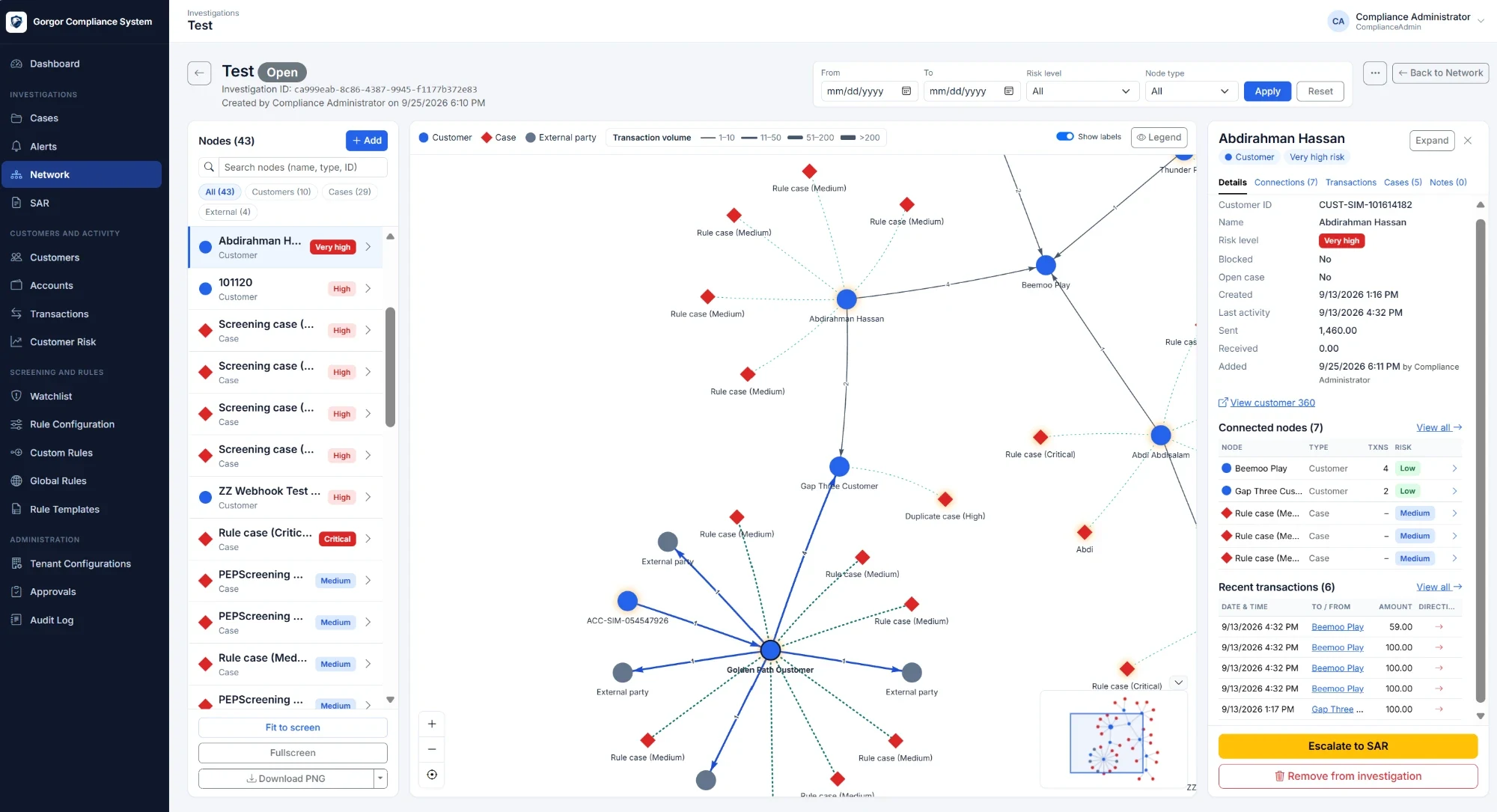
Network analytics
Money laundering rarely involves one account. Gorgor links customers, accounts, cases and external parties so investigators can see how funds move between them, across every channel.
Governance & security
Administrators, analysts and approvers see and do only what their role allows.
Maker-checker approvals on the decisions that matter most.
Human and automated actions are logged with time, tenant, actor and entity.
Each tenant's data, rules and users are kept separate, with central oversight for administrators.
Implementation
We don't just hand over software. Our banking and fintech engineering team connects Gorgor to your systems and tunes it to your policies.
Connect each of your channels, from core banking and agency banking to mobile wallets and payment systems, so data flows into Gorgor automatically.
Rules, risk models, roles and approval workflows set up to match your AML policy and risk appetite.
Hands-on training for your compliance team and ongoing support as regulations and your business evolve.
Banks, fintechs, microfinance institutions and mobile wallet operators that need to screen customers, monitor transactions and manage AML investigations in one place.
Yes. Each institution is a tenant, and you can connect as many channels as you run, such as core banking, agency banking and mobile wallets. Rules can apply to all channels or target one.
No. Compliance teams configure scenarios, thresholds, look-back windows and risk factors themselves. Every rule change goes through maker-checker approval and is recorded in the audit log.
Every action by a user or an automated job is logged with time, tenant, actor and entity. Cases keep their evidence, and SARs are tracked from draft through filing.
Yes. Each tenant's data, rules and users are isolated, and role-based access controls what administrators, analysts and approvers can see and do.
Our team integrates your channels, configures rules, risk models, roles and approval workflows to your AML policy, and trains your compliance team, then supports you as regulations and your business change.
Book a personalized demo and we'll walk you through screening, monitoring, risk rating and case management using scenarios relevant to your institution.